
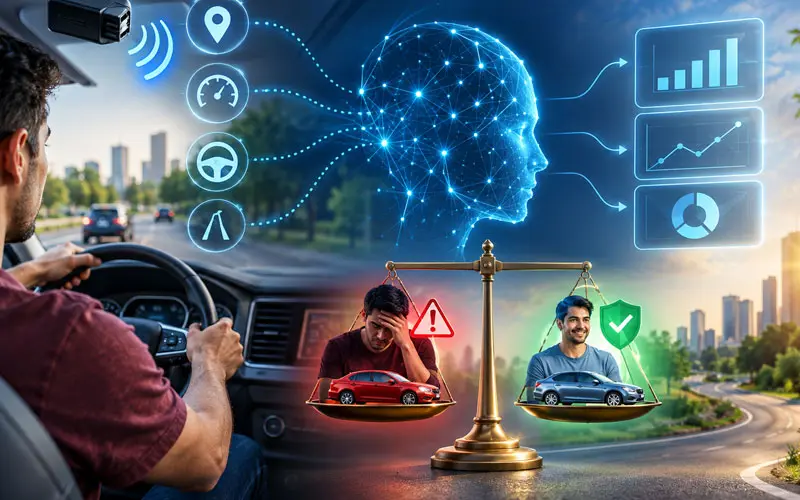
How Telematics and AI are Creating Fairer Rates for High-Risk Drivers

A good driver who at some point was labeled high-risk typically has to wait a long time before their current habits are reflected in their pricing, paying a penalty for the society’s reliance on lagging indicators. And, for certain segments of the driving population, the status quo pricing seems somewhat unfair. Young drivers, who statistically are the biggest accident risk, are assumed to be high-risk just because of their age. The same is true for older drivers, who are charged more because they’re in a high-accident age bracket. Telematics and AI offer a way out of this quagmire.
The old model punishes history, not behavior
Non-standard car insurance has always heavily relied on proxies. How many years of history do you have, is your credit in order, how many miles are you driving a year, what’s your zip code, what’s your age… all these factors are fed into an algorithm and out pops a figure to slap on top of your rates. None of those things actually measure how the driver is driving right now, but those are the metrics the math comes up with.
As a result, the bad drivers pay more and the good drivers pay less… but the insurers make money off the bad drivers (at least in theory) and lose money on the good drivers. This inversely creates more bad drivers and good drivers, so the good drivers can get an even better rate. The bad drivers, though, they’re getting what they pay for…which is a lot more.
A real path back to lower rates
The carriers providing the policies are still trying to turn a profit, of course. That means your rate is almost certainly going to be higher than it would be for someone with a clean record if you were to go back onto the regular market today. But it should still be a more accurate reflection of what it would cost to cover you. This is also why platforms built specifically around Non-Standard Auto Insurance Ai are worth a look for anyone stuck paying elevated rates because of a past ticket or accident. To make a reasonable assessment of that, they’re going to want your consent to access a little more data about you than a standard carrier would ask for. Once they have that, you’ll receive quotes online or over the phone that you can consider along with the alternatives.
What telematics actually measures
Data from telematics devices and smartphone apps can track hard braking, rapid acceleration, cornering force, speeding in relation to posted limits, phone handling and time-of-day driving. With mileage, this creates a rolling behavioral record, rather than a snapshot in history. However, none of the data is particularly meaningful on its own. Raw acceleration numbers or a few hard-brake events don’t tell an insurer whether someone is a safe driver. That’s where AI and machine learning enter the picture and start to weigh dozens of variables against claims data, correlating specific driving patterns with actual loss frequency and severity. A driver who brakes hard twice a week during highway merges is different than one who does it near school zones at 3 PM. The context matters, and AI is what makes that context usable at scale.
AI pricing isn’t automatically fair
The technology is advancing rapidly and the insights will only get sharper. What comes next could go a long way toward either reinforcing or dismantling the same deeply unfair systems the industry says it’s trying to fix. Insurers could use telematics to justify redlining poor neighborhoods with ever more precise, ever more powerful data. Or they could levy surcharges based not on your credit score or your ZIP code but on how often you take your eyes off the road to look at your phone. Flawed as it is, it’s not a hard choice.
What to check before signing up
Every telematics program isn’t made equal, and the fine print matters more for high-risk drivers than anyone else.
For example, what’s the maximum discount, and is there a cap regardless of how carefully you drive? Does the insurer use the data only for the discount, or does the information help determine your rates at renewal, which might be less rewarding if you have the least to spend to begin with? Most important, if it’s your performance history that helped put your premiums up long ago, what makes you think your telematics will ever bring them back down? There are no telematics programs that advertise: “We turn high-risk drivers back into customers with self-esteem!”